
Ottawa is a vibrant and fascinating city with a unique history, evolving from a small settlement into the capital of Canada. It boasts landmarks, distinctive structures, artifacts, and symbols that its residents hold dear. While some city symbols may seem unusual to tourists exploring Ottawa’s history, they are cherished as a part of Canada’s legacy by locals. Explore the intriguing world of Ottawa’s symbols with ottawayes.com.
The Chain of Mayors’ Names
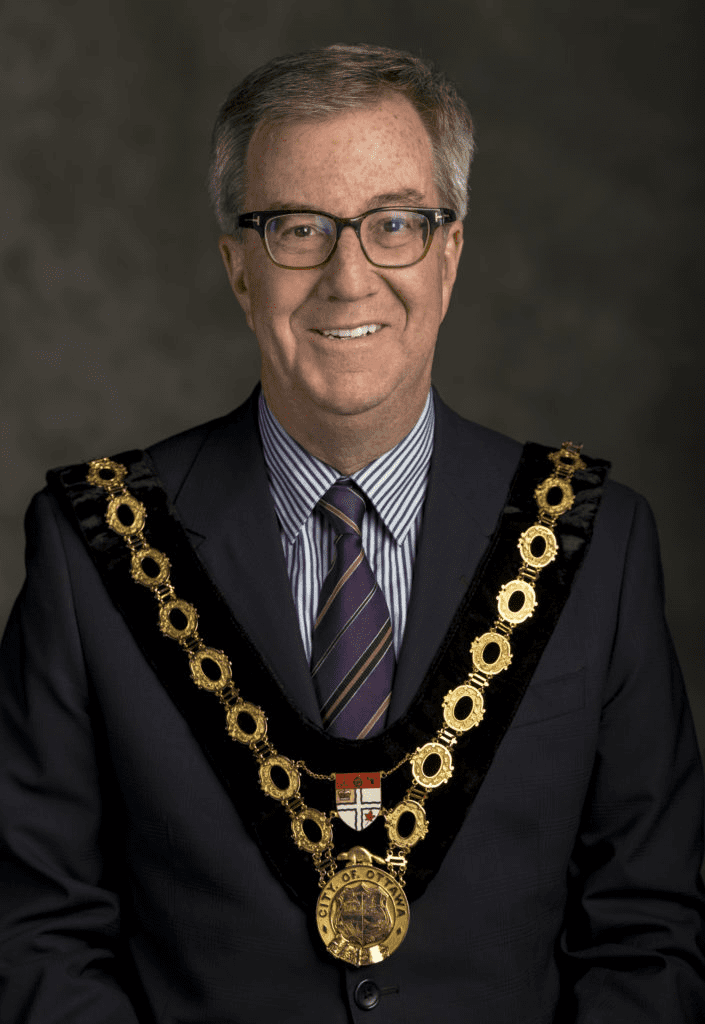
The city was once known as Bytown and received its current name in 1850. In 1872, Ottawa established its mayor’s office, and a special committee decided that the office should display distinguishing symbols at council meetings and public events.
This distinction took the form of a gold chain adorned with medallions engraved with the names of Bytown’s mayors (1847–1854) and Ottawa’s mayors (from 1855 onward). Over time, new links with engraved names were added. The chain was reconstructed in 1956, incorporating Ottawa’s official crest. Made of 10-karat gold, the chain includes a central medallion inscribed with “City of Ottawa,” showcasing the mayor’s prominence during public engagements.
Unique Table and Chair
Every city has its heritage, and sometimes it takes on an unusual form. In the case of Ottawa, an extraordinary part of its legacy is the ceremonial table and chair. Over the centuries, these items have become significant historical treasures of the city. What makes the table and chair so unique is their role as ceremonial artifacts for the Mayor of Ottawa, used exclusively on special occasions.
A Special Table for Important Meetings
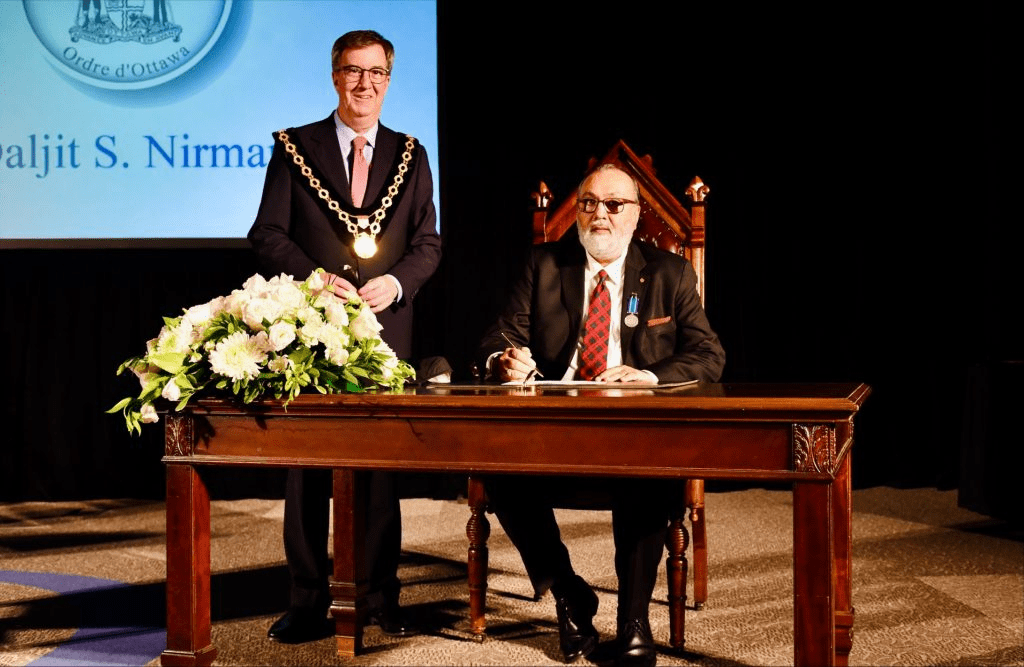
This antique table has been passed down through generations of Ottawa mayors. It once served as a daily work desk for city leaders and is now considered a cherished part of the city’s heritage. In the 21st century, the table is used exclusively for ceremonial purposes, such as signing documents with visiting dignitaries and local officials.
The last time the antique mayoral table was used as a ceremonial desk was in the 1950s, during the tenure of Mayor Charlotte Whitton. This document-signing ceremony played a significant role in reviving traditions and symbols of city governance, such as the ceremonial attire of the mayor and other official items.

The antique ceremonial table, dating back to the early 20th century, is crafted from mahogany and mahogany veneer. Designed in a neoclassical style, the table features intricately carved details in the shape of acanthus leaves. Its legs are made of brass, and it includes three dovetail-jointed drawers. Notably, no maker’s mark has been found on the table, adding an air of mystery to its origin.
The Chair for Ceremonial Events
Much like the table, the ceremonial chair is a valued piece of Ottawa’s antique collection and an essential symbol of the city’s heritage. These ceremonial items have been passed down from generation to generation, serving as a tangible link to Ottawa’s history. Today, both the chair and the table are preserved as symbols of the city’s legacy for residents of Ottawa and Canada as a whole.
The ceremonial chair, dating back to the early 20th century, was likely used in the everyday operations of Ottawa’s city council. Now, it is reserved exclusively for special ceremonial occasions involving various officials. The chair’s rich red leather upholstery complements the ceremonial desk, creating a cohesive and distinguished appearance for formal events.
The chair is crafted from solid oak in a neo-Gothic style. Its backrest is triangular and pointed, adorned with carved finials in the form of heraldic fleurs-de-lis. The armrests and front legs feature turned details, created using a lathe. The seat is upholstered in luxurious deep-red leather with a tufted backrest. Interestingly, the padding of the backrest is entirely organic, potentially made of hay or animal hair. Despite its historical significance, the chair bears no visible maker’s mark, adding to its enigmatic allure.
The Robe

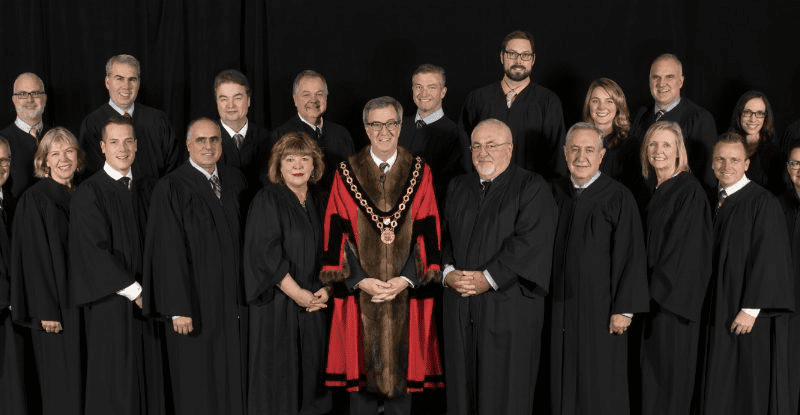
Mayors of Ottawa began wearing ceremonial robes in the 1870s, following a directive issued by a municipal committee. The decree mandated that the council appear at meetings and public events with distinctive symbols to set them apart from others. Along with the mayoral chain, the robe became a key identifier, distinguishing the mayor from other council members.
This tradition originated from English towns, where the wearing of ceremonial robes by mayors was an entrenched custom. In Ottawa, mayors did not wear the robe daily but reserved it for significant occasions. Much like the ceremonial chair and table, the robe was a symbolic accessory used for special events in the city.
By the early 20th century, however, the practice of wearing the mayoral robe had fallen out of fashion. It wasn’t until the 1950s that the tradition was revived by Charlotte Whitton, a prominent figure in Ottawa’s history. Whitton reintroduced the robe, along with other long-lost traditions of the city’s mayoral office.
The revival of these customs coincided with the coronation of Queen Elizabeth II in London and the centennial celebration of Ottawa’s founding. To mark these significant milestones, Whitton acquired a new robe from renowned English outfitters “Ede & Ravenscroft,” restoring its status as an essential symbol for civic ceremonies.
The tradition of wearing the mayoral robe continues into the 21st century. Ottawa’s mayors don the robe during key ceremonial events held in the city.
The robe itself is a striking symbol of Ottawa’s heritage. It is crafted from red silk, adorned with muskrat fur trim on the lapels, and features black velvet accents on the sleeves and hem. According to tradition, the robe is worn with a lace jabot, a triangular hat, and the mayoral chain bearing the names of previous mayors. These elements together create a distinguished ensemble that underscores the historical significance of Ottawa’s civic leadership.
About the Coat of Arms
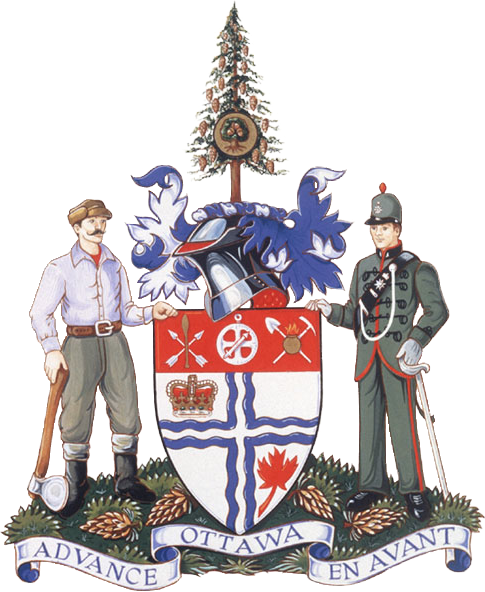
A coat of arms is a symbolic representation embraced by most cities, embodying their identity and heritage. Originating in Europe during the 12th century, the coat of arms initially served a practical purpose. Knights would wear it on tunics over their armour to ensure they could be identified in battle.
Over time, the coat of arms evolved beyond its battlefield function. It became a recognized emblem representing cities, schools, churches, and various institutions. This heraldic symbol grew to signify authority, heritage, and the values of the entity it represented, marking its unique identity and connection to tradition.
The History of Ottawa’s Coat of Arms
Ottawa’s coat of arms was introduced in 1954, with its official adoption taking place in 1955. Despite the city’s significant expansion in 2001, when several municipalities were amalgamated into Ottawa, the city council decided to retain the original coat of arms. This decision preserved the emblem’s historical significance and continuity, maintaining its role as a representation of Ottawa’s identity since its creation in 1954.
The Symbolism of Ottawa’s Coat of Arms
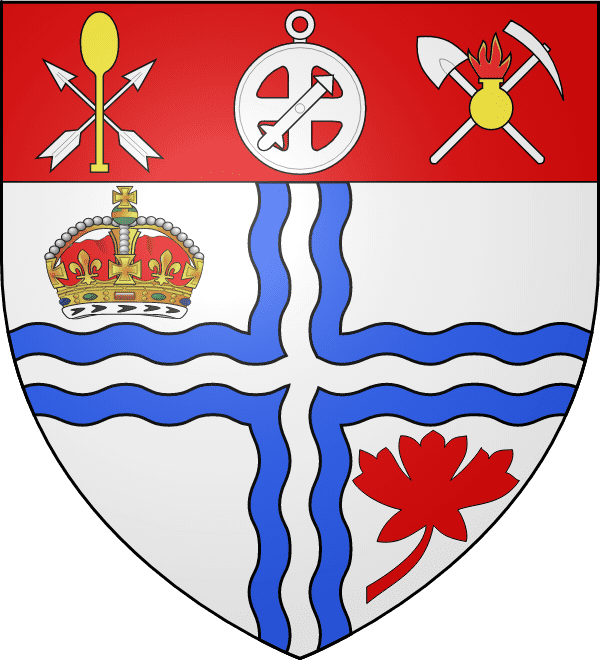
The coat of arms of Ottawa is rich in symbolic elements, each representing a unique aspect of the city’s heritage, geography, and history:
- The Blue and White Cross: This central feature symbolizes the confluence of the Ottawa River with its two tributaries, the Gatineau and Rideau Rivers. This strategic location determined the city’s future settlement.
- The Royal Crown: Positioned above the cross on the left, the crown signifies Ottawa’s designation as the capital of Canada by Queen Victoria in 1857.
- The Maple Leaf: Located at the bottom right of the cross, it represents Ottawa as the capital of Canada, reflecting the nation’s emblem.
- The Canoe Paddle: This element pays homage to the Ottawa Indigenous people, the region’s original inhabitants, who named the area and played a vital role in its early history.
- The Astrolabe: A symbol associated with Samuel de Champlain, the first European to explore the Ottawa region in 1613. Champlain was instrumental in mapping the area and establishing relations with the Indigenous people.
- The Pick and Shovel Crossed Behind a Grenade: Representing the Royal Engineers, these tools acknowledge their pivotal role under Colonel John By’s command in constructing the Rideau Canal, which connected the region’s waterways. The city’s original name, Bytown, was a tribute to Colonel By.
- The White Pine: This tree symbolizes the area’s natural resources and the timber trade, which historically attracted settlers and drove economic growth in Ottawa Valley.
- The Medallion Depicting an Oak Tree: Reflecting the old seal of Bytown, it connects modern Ottawa to its roots as a pioneer settlement.
- The Motto: The phrase inscribed on the coat of arms reads, “Advance-Ottawa-En Avant.” This motto reflects the city’s progressive spirit. The word “Advance” also ties back to a historic battle cry, emphasizing readiness and unity. The bilingual nature of the motto highlights Canada’s commitment to linguistic duality, as established in the British North America Act.
- The Lumberjack: A tribute to the timber trade, which was foundational to the region’s development long before Ottawa became a city.
- The Officer of the Rifle Regiment: This symbolizes the Rifle Regiment and its successors, who have served in Ottawa since 1865.
The Tulip as Ottawa’s Symbol

On October 24, 2001, the tulip was declared the official flower of Ottawa. The history behind this symbol is both fascinating and deeply cherished by the city’s residents, continuing to be celebrated well into the 21st century.
During World War II, the Dutch royal family found refuge in Stornoway, which is now the official residence of the Leader of the Opposition in the House of Commons. On January 19, 1943, Princess Margriet, daughter of the late Queen Juliana of the Netherlands, was born at the Ottawa Civic Hospital. Concerned that Princess Margriet might be considered a Canadian citizen rather than a Dutch one, the Kingdom of the Netherlands petitioned the Canadian government to temporarily declare the Ottawa hospital extraterritorial. This ensured that Princess Margriet would retain her Dutch citizenship.
In the autumn of 1945, as a gesture of gratitude to Canada for sheltering the royal family, Queen Juliana of the Netherlands sent a series of gifts to the Canadian people. Among these were 100,000 tulip bulbs, symbolizing her appreciation for the safe haven provided to her family and acknowledging the vital role Canadian troops played in liberating the Netherlands. Queen Juliana continued this tradition throughout her life, annually sending thousands of tulip bulbs to Canada. Her daughter, Queen Beatrix, and grandson, King Willem-Alexander, have upheld this tradition.
Since 1953, Ottawa has hosted the Canadian Tulip Festival, an annual celebration of the tulip bloom. This vibrant event highlights the enduring bond between Canada and the Netherlands and pays tribute to the flower that has become an enduring symbol of Ottawa.
Creation of Ottawa’s Flag

The Ottawa flag was introduced in 2001 during the city’s amalgamation with surrounding municipalities. This expansion required a new identity to symbolize the unification of all the municipalities under one banner.
A citizen group spearheaded the flag’s design, conducting discussions with over a thousand Ottawa residents from various regions. These consultations revealed key themes that needed to be reflected in the flag:
- Quality of life
- Water resources and green spaces
- Technologically advanced businesses
- Historical heritage
- Ottawa’s importance as Canada’s capital
The flag was designed to represent a modern, dynamic, and attractive city—a vibrant and exciting place to live.
Meaning of Each Element on the Flag
Each detail and element of the Ottawa flag carries unique significance and plays an important role in representing the city:
- The Letter “O”: As the central element, the “O” represents Ottawa as the nation’s capital. It exudes energy and brightness, subtly resembling both a maple leaf and Parliament Hill.
- White Stripes: These symbolize unity and harmony among Ottawa’s diverse communities.
- Colours: The blue signifies Ottawa’s rivers, while the green represents the vast forests and commitment to environmental stewardship.
The City’s Motto as a Symbol of Ottawa
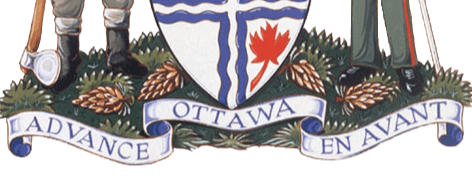
The official motto of Ottawa, displayed on the city’s coat of arms, is “Advance-Ottawa-En Avant.”
The interpretation of the motto is straightforward. The word “Advance,” historically a battle cry, was used to distinguish allies from enemies in combat. While most Canadian mottos are not bilingual, Ottawa’s was intentionally chosen to reflect the bilingual provisions of the British North America Act, which affirmed Ottawa’s status as the capital of the Dominion.
The previous motto, used from 1855 to 1954, was lost in the 1931 fire at Ottawa’s city hall. The current motto was first adopted alongside the new coat of arms in 1955.